Why Autonomous AI Is a Bad Idea (Most of the Time)
Why production AI systems need explicit boundaries, human approval, and accountability instead of unrestricted autonomy.
Autonomy is the most seductive promise in AI.
An assistant that doesn’t ask questions. An agent that just handles it. A system that goes end-to-end without waiting on humans.
On slides, autonomy looks like progress. In production, it often looks like unowned risk.
This isn’t an argument against AI. It’s an argument against removing brakes from systems that can already move very fast.
The Seduction of Autonomy
Humans are the bottleneck.
We review slowly. We hesitate. We ask annoying questions like “are we sure?”
So when AI shows up promising:
- fewer approvals
- fewer hand-offs
- instant execution
…it feels like relief.
But in engineering, the bottleneck is rarely the problem. The problem is what happens when something goes wrong. Autonomy optimizes for speed. Reliability optimizes for recovery. Those goals are not the same.
Where Autonomous Systems Break in the Real World
Failures are inevitable. What matters is whether failure is traceable, reversible, and owned. Fully autonomous systems struggle here.
Common failure patterns:
- Actions taken without recorded intent
- No clear audit trail of why a decision was made
- No blast-radius awareness
- No pause before irreversible steps
- No human context when edge cases appear
The issue isn’t that the system made a mistake. The issue is that no one can confidently explain or undo it.
Failure isn’t dangerous. Unowned failure is.
What High-Risk Systems Already Know
Look at systems we trust with real consequences:
- financial transactions
- production infrastructure
- access controls
- incident response They all follow a familiar shape:
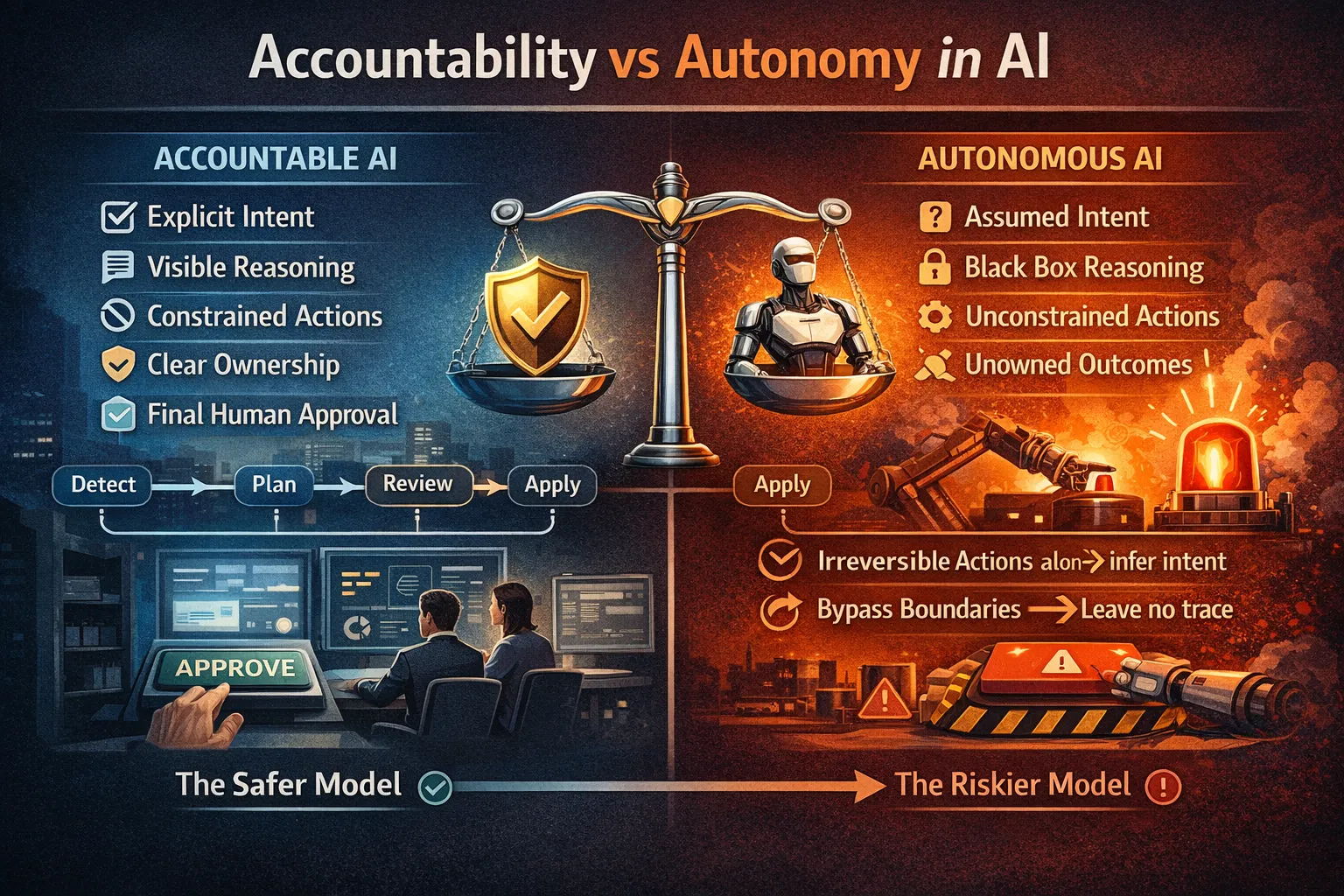
Detect → Plan → Review → ApplyAutomation exists everywhere in this flow. But decision authority does not disappear. Humans don’t click buttons because machines are dumb. They click buttons because:
- accountability matters
- context matters
- reversibility matters
We don’t fear automation. We fear automation without brakes.
Autonomy vs Accountability
Autonomous AI is attractive because it removes friction. Accountable AI is harder because it introduces discipline. But discipline scales better than freedom. Accountability requires:
- explicit intent
- visible reasoning
- constrained actions
- clear ownership
Autonomy often removes all four. That tradeoff is rarely worth it outside low-risk domains.
The Better Model: AI With Brakes
A safer and more powerful pattern already exists. AI should:
- analyze situations
- propose actions
- explain tradeoffs
- simulate impact
- highlight risks
- wait for approval
AI should not:
- execute irreversible actions alone
- infer intent on behalf of humans
- bypass policy boundaries
- act without leaving a trace
This isn’t slowing AI down. This is letting it operate inside reality.
A Practical Example (Not a Thought Experiment)
Imagine an AI assisting during an incident. Instead of:
Issue detected. Fix applied.
You get:
Audit:
- Detected permission mismatch across 3 schemas
- Similar pattern observed in 2 prior incidents
Plan:
- Reapply ownership consistently
- Restart dependent services
- Estimated blast radius: low
- Rollback available: yes
Policy Check:
- Requires human approval for permission changes
Status:
- Awaiting confirmation
Nothing magical happened. Nothing autonomous ran wild.
But:
- risk was surfaced
- intent was explicit
- recovery remained controlled
The smartest AI in the room is the one that knows when to stop.
Why “Just Let It Run” Fails at Scale
Autonomy feels efficient in isolation. At scale, it compounds uncertainty.
When dozens of systems act independently:
- correlation becomes invisible
- accountability diffuses
- failures overlap
- humans arrive too late
Guardrails aren’t overhead. They’re load-bearing structures.
The Future Is Not Autonomous—It’s Accountable
The next generation of useful AI won’t brag about independence.
It will:
- document its reasoning
- respect policy boundaries
- pause when stakes rise
- invite humans at the right moment
Autonomy is easy. Accountability is hard.
Hard things last longer.
The future belongs to AI systems that can explain themselves, wait patiently, and accept a “no.”
Originally published on Medium on December 28, 2025.